Family & Parenting · 7 min read
Why Character Lessons Aren't Landing With Kids Anymore — And the Storytelling Fix Filipino Parents Are Quietly Switching To
It's not that today's children don't care about being kind, honest, or brave. It's that the lessons are reaching them in a format their attention has already learned to ignore.

A nightly ritual that's becoming rarer — and why that matters more than most parents realize.
If you've caught yourself repeating the same reminder to "be kind" or "tell the truth" and watched it bounce right off — you are not doing anything wrong. Most character lessons today are delivered the same way information is: quickly, verbally, and once. Kids' attention simply isn't built to hold onto that anymore.
The pull isn't a parenting failure. It's an environment problem. Between tablets, group chats, and an endless feed of 15-second videos, a child's attention has been trained to expect constant motion — and a five-minute talk about honesty can't compete with that, no matter how well-meaning it is.
Here's what the numbers actually show about that environment:
"The problem was never that my kids didn't want to learn good values. It's that nothing was holding their attention long enough for the lesson to stick." — a mom's comment that keeps echoing in parenting groups
So what actually works? Child development researchers keep landing on the same answer: story, not instruction. A rule told to a child is forgettable. A rule lived out by a character a child has grown attached to tends to stay. It's the same reason a bedtime story outlasts a scolding.
That single insight is the foundation of a simple framework a growing number of Filipino families have started using at home — one that doesn't require a lecture, a worksheet, or a screen.
Introducing the Character Compass Method™
A four-point storytelling approach built into every volume of My Bible Friends — designed to make one value stick per story, every time.
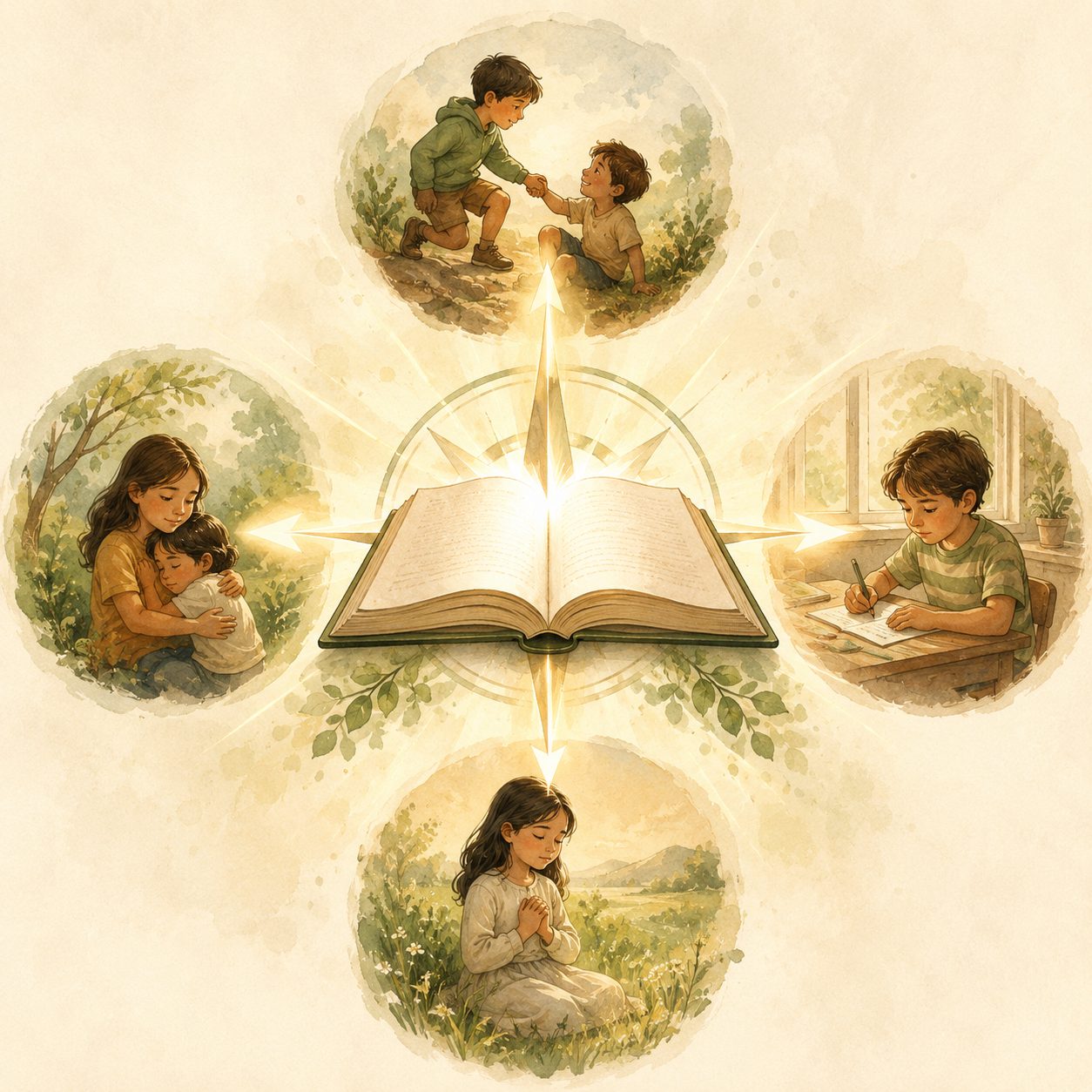
Four Directions. One Story Each.
Instead of teaching values as abstract rules, the Character Compass Method anchors every story to one of four directions a child can actually recognize and return to.
COMPASS
Here's how it plays out on the page: each story in the 10-volume set is built around a relatable Bible character facing a real, age-appropriate dilemma. Rather than closing with a moral statement, the story lets the child see the value in action — then a simple reflection line invites them to connect it to their own day. Repeated across 10 volumes, the four directions of the compass become familiar touch points a child starts to recognize on their own, without being told to.
It's not a workbook. It's not a lecture. It's a page your child will ask you to turn.

My Bible Friends — 10-Volume Storybook Set
The complete hardcover collection built around the Character Compass Method. 600+ pages, full-color illustrations throughout, in a keepsake boxed set designed to be read again and again.
See the Full Collection →Parents who've made the switch describe the same shift: fewer nightly battles over "why do I have to be nice," and more moments where a child brings the lesson up on their own — days after the story was read.
None of this replaces the conversations you already have with your child. What it does is give those conversations something concrete to stand on — a character, a moment, a direction on the compass they already know.
This feature was produced in partnership with My Bible Friends. Statistics cited are drawn from third-party research on children's screen time and reading-aloud outcomes; individual results and reading habits will vary by child.